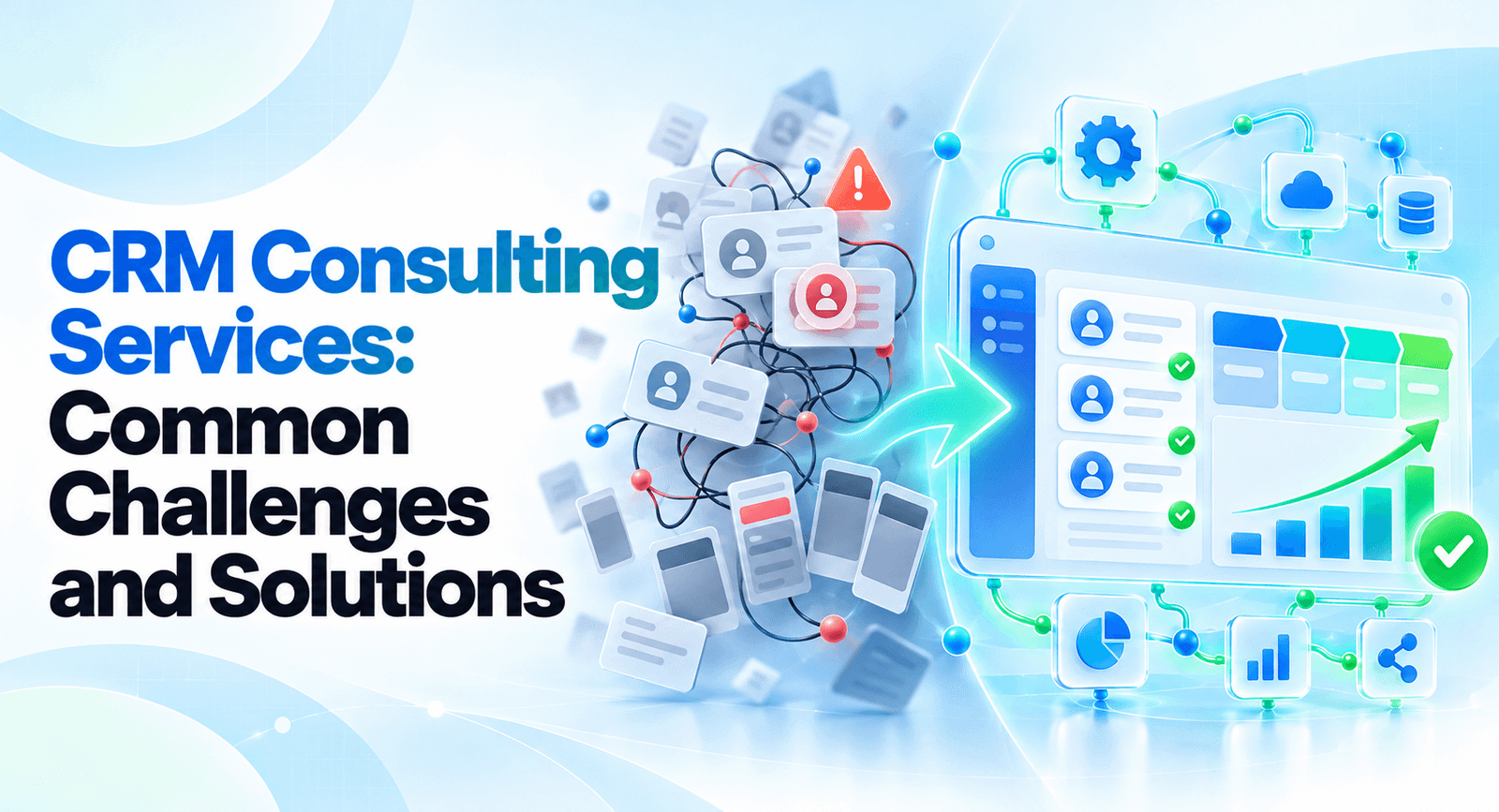
Have you ever invested in a tool that promised to make your work easier, only to discover that using it was more complicated than doing everything manually? Well, that’s exactly how many businesses feel after implementing a CRM system.
A Customer Relationship Management (CRM) system is supposed to organize customer information, simplify sales processes, and improve communication. But sometimes, things don’t go as planned. Employees struggle with the software, customer data becomes messy, and important opportunities slip through the cracks.
That’s where CRM consulting services can make a difference. With the right guidance, businesses can overcome technical challenges, improve their processes, and finally get the value they expected from their CRM investment.
Before discussing solutions, it’s important to understand why CRM systems sometimes become a headache.
The problem isn’t always the software itself. Often, businesses implement CRM platforms without clearly understanding their requirements, existing workflows, or employees’ needs.
Imagine buying an expensive kitchen appliance without knowing how to use its features. You might use only a small portion of its capabilities while the rest goes to waste.
Something similar happens with CRM systems. Without proper planning and training, even powerful software can become an unnecessary burden.
Let’s explore the most common challenges and how professional CRM consulting helps address them.
With so many CRM platforms available, choosing the right one can feel overwhelming. Some offer advanced automation, others focus on sales management, and certain platforms are designed specifically for smaller businesses.
The trouble begins when companies select software based on popularity instead of their actual needs. They might end up paying for features they never use or missing important functions.
The Solution:
CRM consultants evaluate your business size, customer management requirements, budget, and existing workflows before recommending a suitable platform.
Instead of choosing the most expensive option, they help identify software that aligns with your business goals and offers room for future growth.
You introduce a new CRM system, expecting everyone to embrace it enthusiastically. Instead, your employees continue using spreadsheets, personal notes, and old processes.
Sounds familiar?
Employees often resist unfamiliar technology because they find it complicated or believe it creates additional work. Unfortunately, inconsistent usage makes it difficult to maintain accurate customer records.
The Solution:
CRM consulting services help businesses introduce systems through structured training and practical demonstrations.
Consultants can also involve employees in the implementation process, address their concerns, and simplify workflows. When team members understand how the CRM makes their jobs easier, they’re more likely to use it consistently.
Imagine calling a customer only to discover that another employee already contacted them yesterday. Even worse, you realize their contact information is outdated.
Poor data management creates confusion, wastes time, and can damage customer relationships.
Duplicate records, missing information, and inconsistent formatting are common problems businesses encounter when managing large customer databases.
The Solution:
CRM consultants establish data management practices that improve accuracy and consistency.
They help businesses clean existing records, organize customer information, define required fields, and establish procedures for maintaining data quality.
This creates a more reliable database that employees can confidently use.
Your sales team uses one platform, marketing relies on another, and customer support manages information somewhere else.
When these systems don’t communicate, employees spend unnecessary time transferring information manually.
This disconnected approach can lead to delays, errors, and incomplete customer histories.
The Solution:
Professional CRM system consulting helps businesses identify integration requirements and connect compatible tools.
For example, integrating CRM software with email marketing platforms, customer support systems, or accounting applications can simplify information sharing.
When properly configured, these integrations reduce repetitive tasks and give teams better visibility into customer interactions.
A CRM should reduce administrative work, not increase it.
However, businesses sometimes continue entering data manually, assigning leads individually, and sending repetitive follow-up emails even after implementing CRM software.
These time-consuming activities prevent employees from focusing on customers and sales opportunities.
The Solution:
CRM consultants identify repetitive processes that could benefit from automation.
Depending on the platform, businesses may automate lead assignments, follow-up reminders, sales notifications, and certain reporting activities.
The result is a more efficient workflow where employees spend less time handling routine administration.
You have a CRM full of information, but can you actually use it to understand your sales performance?
Many businesses struggle to interpret reports, monitor leads, or identify where potential customers abandon the sales process.
Without meaningful insights, making informed decisions becomes challenging.
The Solution:
CRM consulting services help configure dashboards and reports around relevant business metrics.
These might include lead conversion rates, sales pipeline activity, response times, and customer retention.
Instead of reviewing endless spreadsheets, managers can access useful information that supports better planning and decision-making.
Implementing a CRM isn’t a one-time activity.
As businesses expand, teams change, customer expectations evolve, and workflows become more complex. A system that worked perfectly last year might no longer support current requirements.
Ignoring these changes can gradually reduce CRM effectiveness.
The Solution:
CRM consultants can provide ongoing system reviews, optimization recommendations, and support.
Regular evaluations help businesses identify outdated workflows, unnecessary features, and opportunities for improvement.
This keeps the CRM aligned with changing business needs rather than allowing it to become another neglected tool.
Not every CRM consultant will be the right fit for your organization.
Look for professionals who understand your industry, have experience with your preferred CRM platform, and can explain technical concepts in simple language.
Also, pay attention to their approach. A reliable consultant should ask questions about your business challenges before recommending solutions.
After all, successful CRM implementation isn’t simply about installing software. It’s about creating a system that genuinely supports your employees and customers.
A CRM system should make running your business easier, not give your team another problem to solve.
From disorganized customer data to employee resistance and complicated integrations, CRM challenges can affect productivity and customer satisfaction. Fortunately, many of these issues can be addressed through better planning, training, and system optimization.
With the right CRM consulting services, businesses can transform an underperforming CRM into a valuable tool for managing relationships and improving operations.
Because ultimately, the best CRM isn’t the one with the most features. It’s the one your team can actually use to deliver better customer experiences.
Quick Links
Company
© 2026 GHL Protocol. All Rights Reserved.