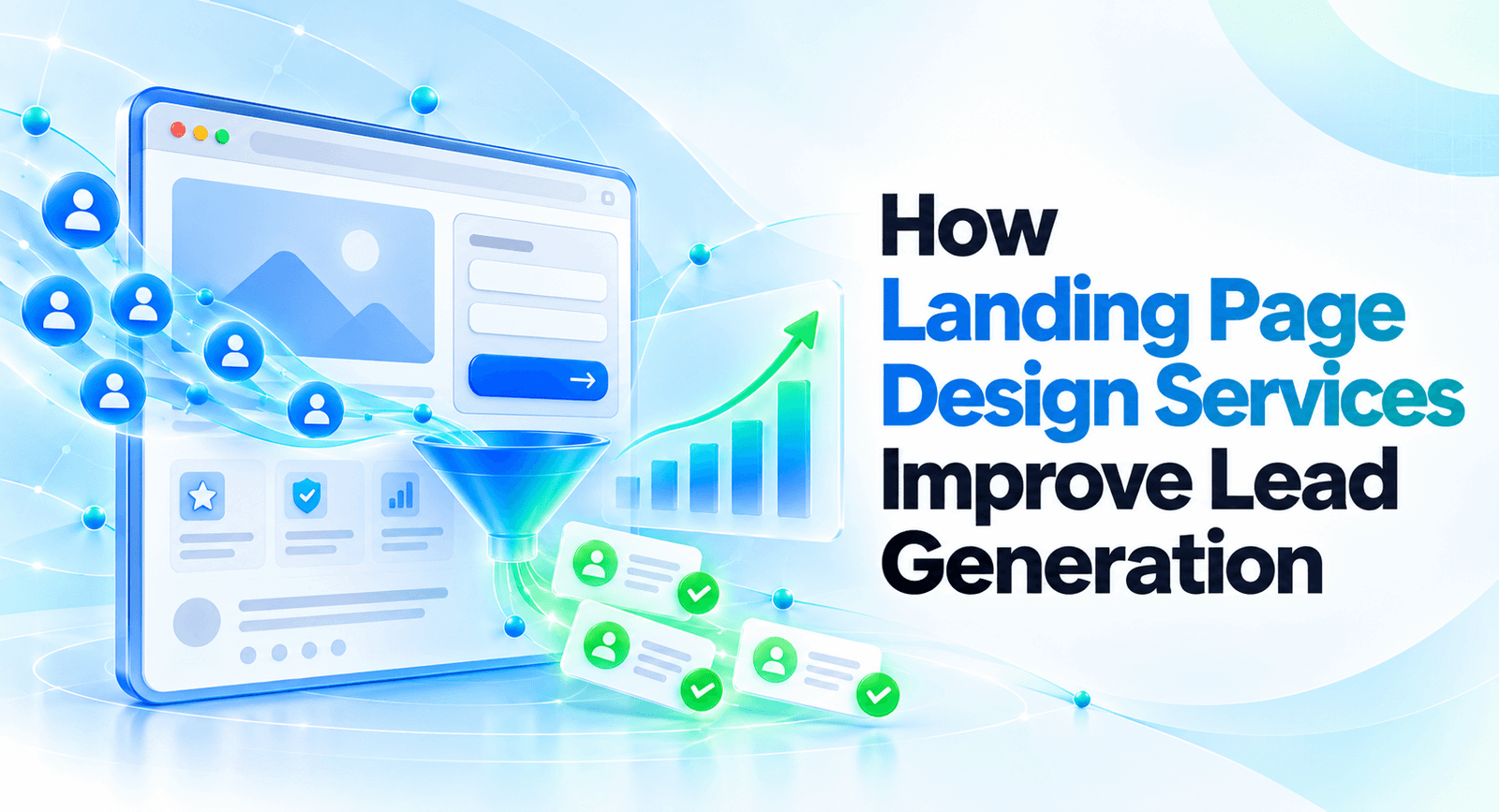
Imagine spending hundreds or even thousands of dollars on online advertisements, getting plenty of clicks, and watching visitors arrive on your website. Sounds exciting, right? But here’s the frustrating part: people visit, scroll for a few seconds, and disappear without filling out a form, making a purchase, or even asking a question.
Where did all those potential customers go?
The problem might not be your advertisements, products, or services. It could simply be your landing page.
Think of a landing page as your digital salesperson. It welcomes visitors, explains what you’re offering, answers their questions, and encourages them to take action. But unlike a salesperson, it has only a few seconds to make a convincing first impression.
That’s where professional landing page design services come in. They turn ordinary website visits into meaningful interactions and, ultimately, more leads for your business.
Let’s clear up a common misconception. A landing page isn’t just another attractive webpage with a colorful button that says “Contact Us.”
It’s a strategically designed page built around one specific objective.
That objective might be encouraging visitors to:
Professional landing page design services combine visual design, persuasive messaging, user experience, and conversion optimization to make these actions easier and more appealing.
The idea is simple: instead of overwhelming visitors with endless information, give them exactly what they need to make their next move.
You’ve probably visited a website that immediately made you question whether the business was legitimate. Maybe the layout looked outdated, the text was difficult to read, or everything seemed randomly placed.
Would you trust that company with your money or personal information? Probably not.
Your potential customers think the same way.
A professionally designed landing page creates a polished, trustworthy experience through clean layouts, readable typography, consistent branding, and carefully selected visuals.
When visitors feel comfortable with what they’re seeing, they’re more likely to explore your offer instead of hitting the back button.
Imagine walking into a store to buy headphones, only to have someone immediately offer you televisions, refrigerators, laptops, and furniture.
Confusing, isn’t it?
That’s exactly what happens when a landing page contains too many competing messages.
Effective landing page design eliminates unnecessary distractions and focuses attention on one primary call to action (CTA).
For example, rather than offering five different buttons, a page promoting accounting services might feature one clear message:
“Get Your Free Financial Consultation.”
Everything else on the page supports that action. Visitors don’t have to figure out what to do next because the design makes it obvious.
Here’s something businesses often overlook: customers don’t necessarily care about every technical feature of your service.
They want to know how it makes their lives easier.
Suppose a company sells inventory management software. Its landing page could spend several paragraphs discussing dashboards, integrations, and database capabilities.
Or it could lead with:
“Stop Guessing What’s in Stock. Track Your Inventory in Real Time.”
Which message sounds more interesting?
Professional designers work with conversion-focused copy to highlight customer problems, explain practical benefits, and present solutions in language visitors actually understand.
Clear messaging helps customers recognize the value of an offer without doing extra research.
Picture this: someone clicks your advertisement while waiting for coffee. Your page loads, but the text is tiny, the buttons overlap, and the contact form requires endless zooming.
That potential lead is probably gone before their coffee arrives.
Responsive landing page design prevents frustrating experiences like these.
A mobile-friendly page should offer:
Mobile optimization isn’t just about making your page look attractive on a smartphone. It’s about removing the little inconveniences that stop interested visitors from converting.
Let’s say you’re offering a free consultation. A visitor clicks your CTA and discovers a form requesting their full name, email, phone number, company address, annual revenue, job title, and ten additional details.
Suddenly, that free consultation feels like paperwork.
Long, complicated forms can discourage visitors, particularly when the requested information seems unnecessary.
Professional landing page design services improve forms by focusing on essential details and making the process feel effortless.
A simple name, email, and relevant inquiry field may be enough to start the conversation.
For businesses needing additional qualification, a short multi-step form can sometimes offer a more manageable experience. The important thing is testing what attracts genuinely interested leads, not merely collecting the most submissions.
Would you feel more comfortable hiring a company that only talks about how wonderful it is, or one that shows genuine customer experiences and successful projects?
Most people want evidence before committing.
That’s why effective landing pages strategically include trust-building elements such as customer testimonials, recognizable client logos, authentic reviews, case studies, and relevant certifications.
These details answer a question visitors may never ask directly:
“Can I trust this business to deliver what it promises?”
Placing a relevant testimonial near a contact form or CTA can help reassure visitors at the moment they’re deciding whether to take action.
Just remember that genuine, specific testimonials are far more convincing than exaggerated claims.
Here’s a secret: even a beautifully designed landing page doesn’t always perform perfectly on its first launch.
Sometimes changing a headline makes the offer clearer. Other times simplifying a form or repositioning a CTA produces better results.
That’s where conversion testing becomes valuable.
Professionals can evaluate metrics such as conversion rates, form completion rates, and visitor behavior. They can also run A/B tests to compare different versions of important page elements.
Instead of making random changes based on personal preferences, businesses can use actual visitor behavior to guide improvements.
Over time, this process can strengthen lead generation while helping companies make better use of their marketing budgets.
Not every conversion problem requires rebuilding your entire website.
If your existing website functions well but a particular advertising campaign isn’t generating enough inquiries, a dedicated landing page might be the smarter investment.
However, if visitors consistently struggle with navigation, outdated content, or poor mobile usability across multiple pages, a broader website redesign may be necessary.
The two approaches can also work together. A redesigned website strengthens your overall digital presence, while dedicated landing pages support specific campaigns and lead generation goals.
Getting people to visit your website is only half the battle. What happens after they arrive determines whether your marketing efforts produce real opportunities.
Professional landing page design services help bridge that gap by creating focused, trustworthy, and user-friendly experiences that encourage visitors to take action.
Because at the end of the day, your business doesn’t just need more website traffic. It needs more of the right visitors turning into genuine leads, meaningful conversations, and paying customers.
Quick Links
Company
© 2026 GHL Protocol. All Rights Reserved.